Friday, August 15, 2014

Tuesday, July 15, 2014
A BOOK REVIEW by Luis G. Lobo

A Book Review by Luis G. Lobo
The Next America by Paul Taylor
This work by Paul Taylor and the Pew Research Center in DC
provides a window into the present demographic picture, the here and now. My friends at the Pew Center and I have developed a mutually beneficial relationship over many years through Roberto Suro, previous director of the Pew Hispanic Center and now on faculty at USC – Irvine, and Rakesh Kochhar, senior researcher at Pew.
The Next America discusses the post-Great Recession impact
on a hobbled economy during the mid-term of the Baby Boomer’s generation, and
career cycle - the last of who will “retire” in the next 10-12 years. The
over-supply of now, “can’t retire” Baby Boomers is creating a job lockout for Millennials, who witnessed the undoing of
their parent’s financial stability in 2008. Most significantly, The Next
America portrays a permanently altered national fabric, contributed by the
surge of U.S.-born children of Latino and Asian immigrants now in their 3rd
generation.
This multicultural block of U.S.-born children of immigrants
impacted the 2012 Presidential elections where the majority of Asians, Latinos,
and Blacks voted for Obama. Given the continued negative dialogue by the
Republican Party against immigrants (i.e., Latinos, Asians,), it is highly
probable that this will also impact the 2016 elections. (See Chapter 6, pp
84-86).
The role of women in America has also reached a state of
permanent change. This, along with
racial minorities predicted to become the majority by 2030 will continue to
significantly change the national fabric.
The Next America should give us pause as to how we must
reach and serve clients today. “Tomorrow” is now “Today.” We have learned
firsthand in our multicultural markets, that we must persistently be visible
where people exist. It is also imperative that we use social media, and
electronic delivery channels to drip financial knowledge on our households,
businesses, and personnel, to uncover needs they may have not yet identified as
crucial to their future and financial success (insurance, home ownership,
investments, etc.).
I believe that we must reflect the communities we
serve to be relevant and successful, thus giving us ample
opportunity to educate and serve their financial needs.
I have noted key areas to read that follow.
Thank You!
The Next America
Chapter
2: “Millenials and Boomers”
Page 24 - “In the early 1980s before most Boomers started
raising families, they were called too selfish to have children…too involved in
their lives...accused of moral relativism, too politically correct. No one
blamed the World War II generation for the Vietnam War, pollution, nor
discrimination against black, women, and gays.
Page 28 - “…born in 1984, you were in middle school when the
Columbine massacre happened; in high school on 9/11/01…”
Chapter
3: “Generation Gaps”
Page 40 – Millienial’s view of Boomers is not substantially
different of older generations and are slightly less critical of business than
the views of Baby Boomers.
Chapter
4: “Battle of the Ages”
Page 47 - Even when
multiple generation don’t live in the same home, they look after one another in
other ways…Boomers have already inherited $2.4 trillion from the Greatest
Generation with another $6 trillion forth coming.
Page 54 – 43% say the government is responsible for a
minimum standard living for older people. 40% say individuals and families are
mostly responsible. 14% say equally responsible.
Chapter
5: “Money Troubles”
Page 59 – if a 65-year old married retiree were to convert
$120,000 into a standard annuity today, it would yield $575 per month. $120,000 being the typical balance today for
the 60% that have such a program on the cusp of retirement. 75% of those on the
cusp of retirement have $30,000 or less in retirement savings.
Page 64 – Figure 5.4 – In 2011, 22% of households age 35 or
younger are in poverty.
Chapter
6: “The New Immigrants”
A. “Immigrants
are strivers”: Only the very motivated uproot themselves for economic,
religious, or political freedom. The
United States’ 325,000,000 population has 42 million immigrants and 37 million
U.S.-born children of immigrants: 24 % (immigrants and U.S.–born children of
immigrants).
B. College
entry rates: Asians - 84%, Whites - 69%, Hispanics - 69%, and Blacks - 65%
(2000-2012 high school graduates eligible to attend a 4 year college)
C. Median
household income, 2012: U.S. Population - $49,000; Asians - $66,000; Whites -
$54,000; Hispanics - $40,000; and Blacks - $33,000.
D. Read
Immigrants and Politics p.84-86.
Chapter
7: “Hapa Nation” (This term means a person that is half
of one race or mixed ethnicity).
A. 15% of all
U.S. marriages are between spouses of a different race.
B. Intermarriage
trend has risen from 2.4% in 1960 to 15.5% in 2011.
C. Read “The
Hispanic Identity Conundrum” page 97 and “The Blacks in Obama’s America”
page
99.
Chapter
8: “Whither Marriage”
Page – 108 …70% of unmarried Millenials say they would like
to get married one day. Money is holding them back…they place marriage on a
pedestal…and associate marriage with positive economic outcomes.
Page 114 – In 2011, 41% of all births in the U.S. were to
unmarried mothers, up from 5% in 1960…mostly to women in their 20s and 30s… 6
in 10 single mothers have live-in boyfriends, when they give birth.
Chapter
9: “Nones on the Rise” – (not religious)
Page – 126 – Figure 9.1: The Churching of America
Rates of church membership: 1906 – 51%; 2000 – 62%.
Page – 132 – Nor are “nones” uniformly hostile towards
organized religion. A majority think that religious institutions can be a force
for a good society.
Chapter
10: “Living Digital”
MUST READ – “Natalie was born in 1988 and was 18 in 2006
when her digital life on message boards began.
Natalie is a digital native, now 26. Natalie has always been
“connected,” this is her principal method of assembly and awareness.
Chapter
11: “Getting Old”
Page 163 – Figure 11.2 - % saying that a person is old when…has
gray hair (13%); Turns 85 (79%).
Chapter
12: “Empty Cradle, Gray World”
Page 171 – Japan’s baby bust is the most acute in the world,
but similar dynamics are taking hold on every continent.
Page 173 – The fertility rate (U.S.) is among the highest in
the wealthy world (Just under 2 per woman). The bulk of the global population
growth will come in the poor countries of Africa and Asia.
Chapter
13: “The Reckoning”
Page 184 – The young today are paying taxes to support a
level of benefits for the old that they themselves have no prospect of
receiving when THEY become old.
Page 194 – Going forward, it’s unrealistic to expect
families to take on more of the challenges of caring for the elderly; it’s
quite possible they will do less.
Appendix:
Includes an excellent array of charts and tables relates to
specific chapters.
http://www.amazon.com/The-Next-America-Millennials-Generational/dp/1610393503
www.LuisLobo.Biz
Saturday, May 31, 2014
AMERICAN ME!
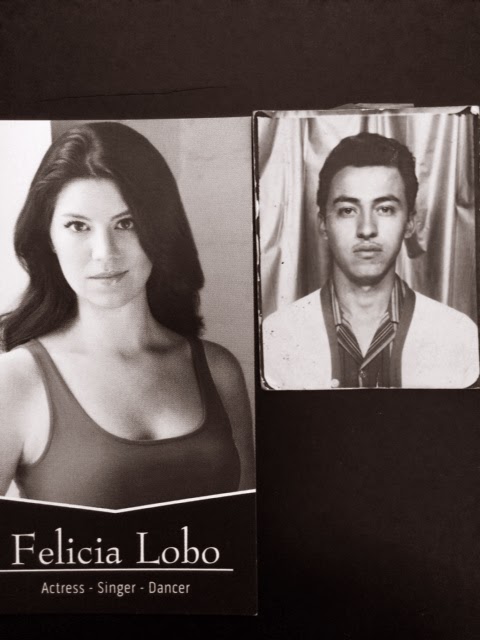
Felicia and her grandfather Gerardo "Jerry" Lobo, both at 21.
A friend of mine said: "there is a book in that Luis!", after I told him that my daughter Felicia Lobo www.felicialobo.com
was graduating New York University, almost 50 years to the month, of my father Gerardo Lobo's arrival at JFK International, February of 1964.
I have written about his motivations to come to the United States, from our ancestral Costa Rica, a young man 21 years of age, the same age as Felicia upon her graduation ( Jerry Lobo could have never imagined....) . Yet, what drives one individual to act, does not necessarily drive another to act accordingly. Felicia has no memory of her grandfather, as he passed away when she was the age of two. Her older brothers Andres and Thomas have few visual recollections of my father. What they all have shared has been an incessant dialogue, over the years, on who he was, what he accomplished for himself and his family and the impact that he had on his community.
Highly motivated individuals cause things to occur. Less motivated individuals watch things occur.
There is the interminable analysis of NATURE VS NURTURE. Malcolm Gladwell has written about drive and motivation in "OUTLIERS" where he gives examples of individuals nurturing their passions, at a rate of 10,000 hours, to be on the competitive plane of sports, academia, or anything. He also wrote "David and Goliath"on the most conventional advantage, David's nature in speed, agility and rifle-like sling, in destroying a visibly superior competitor.
There are also an encyclopedia of work on the subject: Qubein - "The Time is Now. The person is YOU"; Peters - In Search of Excellence"; Pink - "DRIVE"; Useem - "The GO Point". There are 100's of other relatively respected works with all the evidence in the world that proves the point being conveyed: "if YOU do this and that, then, this and that will occur."
Sure, in a frozen and controlled universe it may occur. We do not exist in a frozen and controlled universe. Our lives are crashing forth, wether we are consciously involved or not, on a time continuum that ultimately ends in death. Very motivated individuals recognize this race against time. Everyone else lives day to day, tacking to the winds, simply trying to make it at some level acceptable to their own self-esteem.
What causes a child to sing before she can rise to hold herself up on her crib? We did not actively play music in our little house in Burlington, NC. What motivation seeks to understand the written word before entering the public schools, her day school teacher telling my wife: "Felicia can read", at three years of age. How can a child of 10 grasp a grown-up concept of where she wants to live (NYC), and what she wants to pursue (the stage), without an active visual example, such as parents or friends in the entertainment industry?
I believe that the "Immigrant Story" has had a lot to do with the second and even third generation children of immigrants having a bold and driven nature. The history of the United States is that of "A Nation of Immigrants" as written by JFK. I also believe that the children of accomplished individuals have a better chance than others of also becoming successful simply because they have seen it done and it is not mystifying to them. Yet, there are countless individuals; bound by economic, physical, cultural and totalitarian walls, that surmount these challenges across the globe.
Felicia, and my other children, and now my nephew, have had a tremendous advantage in the persistent day-to-day involvement of my wife Debbie. This is the structural organization and moral upbringing that comes with strict boundaries, lots of love and affection, and an ongoing emotional support. A love of self is more important than any degree, and these are earned early or they are not. My grandfather Andres called this the education that is gained at home, not the education that is gained at school.
Just this very moment a child was born, somewhere in the world, with the odds stacked for or against them. That child will be able to "see over the wall" of religious intolerance, political oppression, or economic disadvantages. Because of increasing world-wide freedom, that child will be able to quickly assess his little or large town or village in comparison with the rest of the world relatively earlier than ever before. He or she will make a decision to become a person of impact (motivated), or the thought may not ever cross their mind (unmotivated). IF we can continue to be the greatest country conceived by the mind of man, that child will want to come here above anywhere else.
When that child arrives in this country, young or later in life, all of us and our descendants will be the beneficiaries of the drive, productivity, innovation and ethics from that one point of light. It takes thousands and thousands points of light to continue to illuminate the world.
Gerardo Lobo changed our reality 50 years ago.
CONGRATULATIONS to Felicia!
In the final analysis, your attitude determines your effectiveness in everything, every time! LGL www.LuisLobo.Biz

Subscribe to:
Posts (Atom)